This page relates to This Paper (TBC – in press), from a project led by Zoe Self Davies studying the gaits of three-legged dogs and funded by the Wellcome Trust.
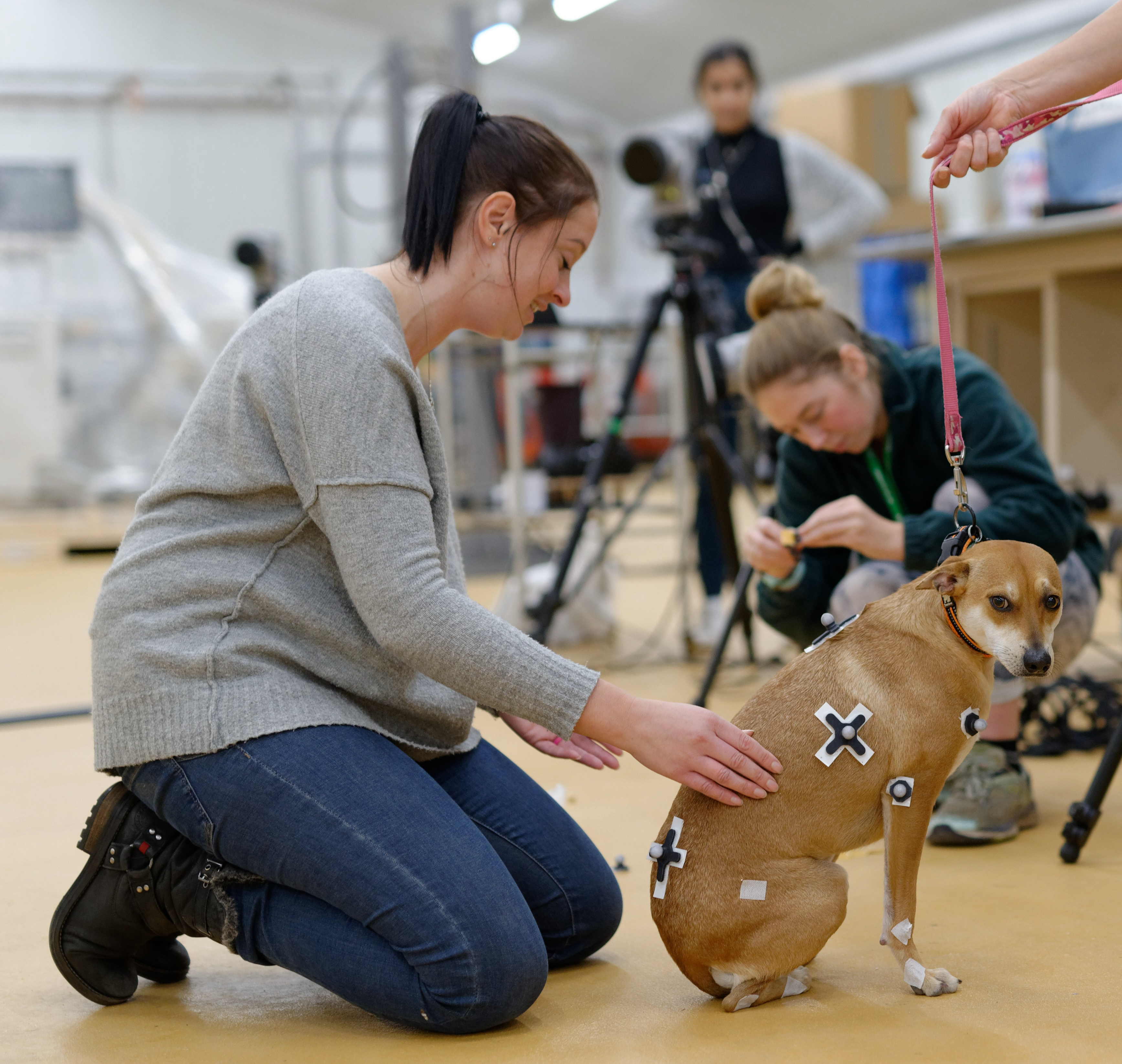
Pet dogs show a remarkable capacity to adapt after limb amputation: they quickly learn how to run on three legs and exercise freely. Indeed, at moderately high speeds it is often difficult to spot that anything has changed: they gallop smoothly with gaits that have direct equivalence to normal quadrupedal trot and pace and gallops (both rotary and transverse). The next six videos show examples of these. But at walking speeds (below) things get quite different.
Trot/pace
Intermediate speed gait of hindlimb amputee approximating a trot.
Gallop
‘Walk’?
At low speeds, however, tripedal dog are immediately obvious, appear odd, and they often prefer to accelerate up to their galloping speeds. The problem is that the single leg cannot ‘walk’. This leaves two gait strategies now described and understood for slow tripedal dogs. One is to match the bouncing single leg to the frequency of the paired legs; but at low speeds and low frequencies that means the single leg bounces up and down excessively. The other is to keep the single leg operating at a comfortable ‘bouncing’ frequency while allowing the paired legs to walk at the lower frequency. This results in a loss of consistent phasing between front and back legs, which is odd to watch and breaks some definitions of what a ‘gait’ is.
So what?
So now we can understand why tripedal dogs look awkward at low speeds – they are clearly somewhat compromised. Simple mechanical constraints account for what has previously been termed ‘random’ – we should not be viewing them as malcoordinated, but as adjusting sensibly to their new circumstance. In terms of rehabilitation, it may make sense to give inexperienced amputee dogs sufficienct space and freedom to ‘gallop before they can walk’ given these fast gaits are trivial – and so presumably simple to learn – modifications of quadrupedal gaits. In terms of robotics, these findings give a starting point for developing strategies for surviving damage of legged robots, or enabling locomotion while limbs are used for other purposes.
 Jim Usherwood Research